Sizing a pool heating system
Heating a pool outside the Perth summer season makes a real difference to how much use you get out of it, but it’s worth understanding the numbers before you commit to a system. Whichever type you choose, heat pump or solar, sizing comes down to two figures: the volume of water your pool holds, in cubic metres, and the temperature you want to maintain. Get those two right and the rest of the sizing follows.
Where the heat actually goes
A pool loses heat constantly to its surroundings, through the pool walls, into the surrounding air, and significantly through evaporation off the surface, which is the single biggest source of heat loss on most pools. The less of that you lose, the less your heating system has to work, which is why an efficient heating choice and a decent cover matter as much as the heater itself.
Isothermal covers cut heat loss in half
A bubble, or isothermal, cover limits heat exchange between the pool water and the outside air. Pricing runs from roughly $150 to $600 depending on the size of your pool, and it typically pays for itself quickly: a cover can reduce heat loss by around half, and it cuts evaporation during the hotter months too. If you’re heating a pool at all, a cover is close to essential rather than optional.
Heat pump vs solar panels, compared
| Characteristic | Heat pump | Solar panels |
|---|---|---|
| Heating speed | Fast | Slow, weather-dependent |
| Upfront cost | Higher | Moderate |
| Running cost | Moderate | Lowest, effectively free |
| Space required | Moderate | Low |
| CO2 emissions | Low | Lowest |
| Works regardless of weather | Yes | No |
The case for a heat pump
A heat pump heats a pool efficiently year-round, and the warmer the air outside, the less energy it needs to run, which makes it economical to operate even though the upfront cost is higher than a straightforward solar setup. Because it isn’t dependent on sunshine, output stays consistent, and most units return 2 to 3 times more thermal energy than the electricity they consume. You can also program a heat pump to bring the pool up to temperature before you’re up in the morning, and pool-specific units use titanium heat exchangers for chlorine compatibility.
The case for solar panels
Perth’s sunshine hours make solar a genuinely strong option for pool heating, and running costs are effectively free once installed, since the energy source is the sun. The trade-off is dependence on the weather: heating is slower, and output drops on overcast days. Pairing solar with an isothermal cover matters more here than with a heat pump, since the cover is what holds the heat you’ve gained during the day through the cooler overnight hours. See solar hot water for how the underlying panel technology works.
Placing a pool heat pump correctly
Distance and airflow are the two things that matter most when siting a pool heat pump.
Distance from the pool. The ideal range is 3 to 7 metres. Close enough for the unit to run efficiently, far enough to give it proper clearance.
Ventilation. The location needs free air circulation around the unit. A confined technical room, a cellar, or any cluttered, poorly ventilated corner is unsuitable, the compressor can overheat and fail prematurely without enough airflow.
Windows and boundaries. Avoid siting the unit directly beneath or beside windows, and keep it away from paths people walk past regularly or close to a neighbouring boundary. Even a quiet heat pump can become noticeably noisier if it develops a fault, and a poor location turns that into an ongoing nuisance.
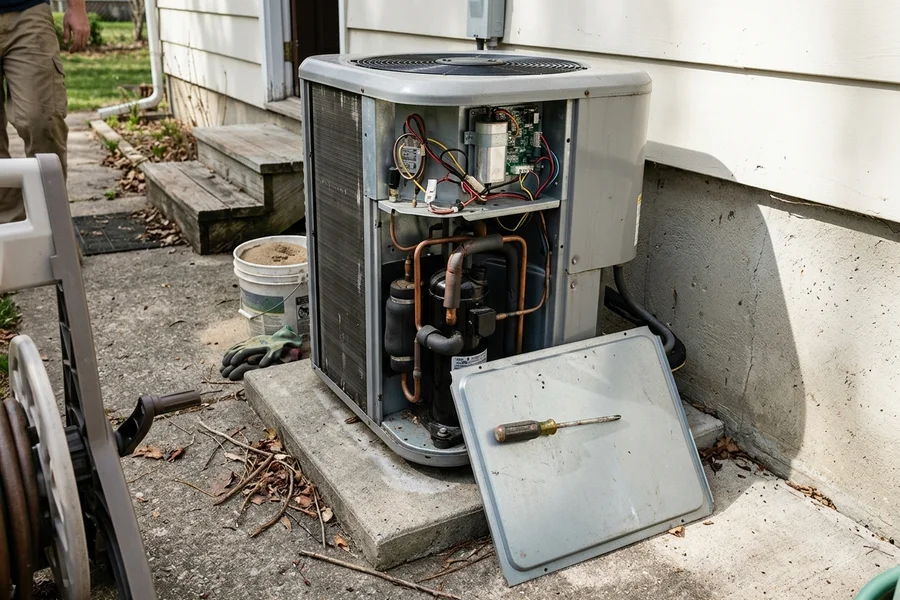
The base. A tamped, level base or a concrete slab is the right foundation, with the unit isolated from the ground and raised slightly on rubber to protect it and let water drain away properly.
Once the water and power circuits are connected, including the correct circuit breaker, the installation is straightforward for a licensed technician, but the site selection is worth getting right before anything is fixed in place.
Whether you’re weighing up a heat pump or solar for your pool, get in touch for a quote based on your pool’s actual volume and the temperature you’re after.